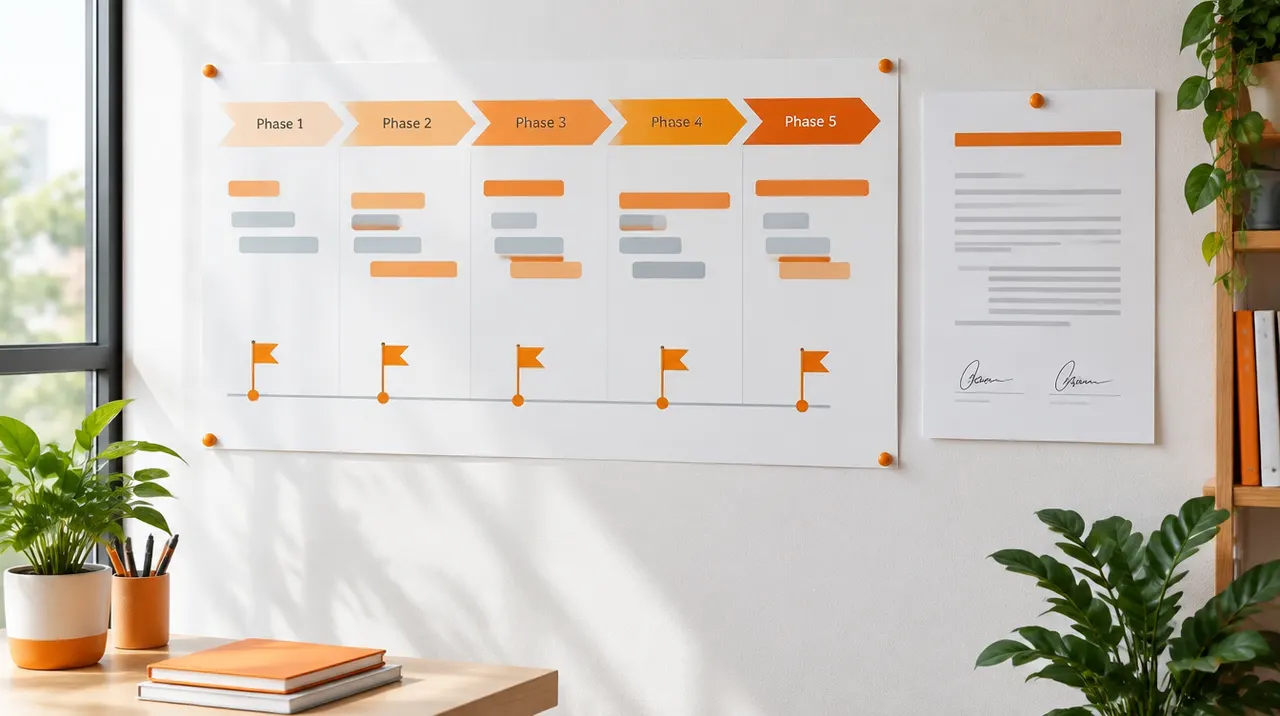
How long does it take to implement an ERP system? For most mid-sized organisations, expect 12 to 18 months from kick-off to go-live, plus a few months of support afterwards. Survey averages sit in the same place: Panorama Consulting's 2017 ERP Report put the average implementation at 16.9 months. In my experience, small, simple projects can be done in six to nine months. Large, multi-country programmes often run two years or more.
The bigger worry is not the average. It is whether your own plan is real. Here is how to tell.
How long does it take to implement an ERP system on average?
Survey numbers move from year to year, but the pattern holds: most projects take longer than planned. In Panorama's 2017 report, 59 percent of respondents went past their original timeline. In its 2021 ERP Report, 54 percent finished within their expected timeline, and those that overran averaged 29 percent over: an 11-month plan became 15 months.
- 17 monthsaverage ERP implementation (16.9 months, 2017 report)
- 59%went past their original timeline (2017 report)
- 29%average overrun for projects that ran late (2021 report)
Source: Panorama Consulting ERP Reports, 2017 and 2021
Realistic ranges by size and approach
Two choices shape your timeline more than the software you pick. Greenfield means a fresh build with redesigned processes. Brownfield means converting your existing system, keeping much of its setup and history. Brownfield is usually quicker to go live, but you carry old design into the new system. The second choice is how you roll out.
Illustrative midpoints from my own programme experience, not survey data. Phased rollouts add each later wave on top.
Big bang
- Everyone goes live on one date
- Shorter total programme, no temporary interfaces
- One very large cutover and data load
- If it goes wrong, it goes wrong everywhere
Phased
- Go live by site, country or module in waves
- Lower risk per go-live, lessons carry forward
- Longer total programme and more cutovers
- Old and new systems run side by side for a while
There is no right answer. Big bang suits a single country with one way of working. Phased suits a group with very different businesses, or one that cannot risk all its sites at once.
Be careful with brownfield promises. A conversion is faster only if your current design is worth keeping. If the old system is full of workarounds and custom code, you either carry that debt into the new platform or clean it up during the project, and the cleanup is where the time savings disappear. Many organisations choose a middle path: convert the core, then redesign selected processes in later waves.
What is the ERP implementation life cycle?
Every method uses different names, but the ERP implementation life cycle has the same shape. SAP's Activate methodology is one well-known example, with six phases: Discover, Prepare, Explore, Realize, Deploy and Run. Oracle, Microsoft and the big integrators use their own versions. Here is the vendor-neutral view, with typical shares of a 15-month programme.
Notice that Discover and select usually sits before the official start date. In my experience, choosing software and a partner can take three to six months on its own, and many published timelines leave it out. When a vendor quotes you a duration, ask which phases it includes and whether hypercare is counted.
- Discover and selectBusiness case, scope and partner choice, before the clock starts
- Months 1 to 2: PrepareTeam, plan, governance and environments
- Months 2 to 5: DesignFit-to-standard workshops and a signed-off design
- Months 5 to 11: Build and testConfiguration, integrations, data loads and test cycles
- Months 11 to 14: DeployUser testing, training, dress rehearsal and cutover
- Months 14 to 15+: HypercareExtra support after go-live, then handover to run
Build and test is the longest phase, and testing is the part most often squeezed when design runs late. Protect it. Data migration runs across the whole cycle, not just at the end; I cover that in how long data migration takes.
Do not forget hypercare. For the first one to three months after go-live, the project team stays on to fix issues, support month-end close and help users who are still learning. Budget for it as part of the programme, not as an afterthought.
What stretches ERP timelines
In Panorama's 2021 report, the most common reason for timeline overruns was organisational issues, such as governance, resistance to change and process redesign. Expanded scope and data issues came next.
Panorama Consulting, 2021 ERP Report. Share of respondents whose projects overran, rounded to whole numbers. A small group, so read it as a pattern rather than a precise figure.
From the client side, I would add three more: slow decisions, key business people who are never really freed from their day jobs, and customisation requests that reopen the design. Each one is a people problem dressed up as a technical one.
Small slips also compound. A design that signs off four weeks late pushes build, which squeezes system testing, which delays user testing, which moves cutover. Because testing, training and data loads all depend on each other, a single late decision early in the programme can cost two or three months at the end. That is why the early phases deserve as much attention as go-live.
How to keep your ERP timeline realistic
- Plan from the go-live date backwards. Fix cutover, dress rehearsal and test exits first, then see if design and build still fit.
- Put quality gates at each phase. Do not start build without a signed design, or user testing without a passed system test.
- Free your business leads. Name them, and agree how much of their week the programme gets.
- Control scope. Every addition goes through a change request with its time and cost impact.
- Keep contingency. Hold time and money back for the overruns the surveys say are likely.
Leadership matters as much as method; see who should lead an ERP implementation. For the patterns that sink programmes, read why ERP implementations fail.
Planning your ERP timeline in ProjectCAPEX
ProjectCAPEX holds the whole life cycle in one programme. You build the plan with phases, milestones, dependencies and a Gantt view, set quality gates between phases, and track testing, training, data migration load cycles and cutover in their own registers. Change requests record their timeline impact in days, and the budget and cost log show what each delay costs. Sponsors see every programme on the portfolio view, and AI agents can propose updates that you approve before anything changes.
To see a full ERP programme laid out, try the demo or start free.